Formula sheetClass 11 and 12
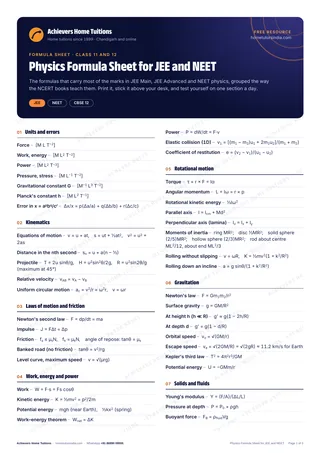
Physics Formula Sheet for JEE and NEET
The formulas that carry most of the marks in JEE Main, JEE Advanced and NEET physics, grouped the way the NCERT books teach them. Print it, stick it above your desk, and test yourself on one section a day.
 Open the PDF
01Units and errors
- Force [M L T−2]
- Work, energy [M L2 T−2]
- Power [M L2 T−3]
- Pressure, stress [M L−1 T−2]
- Gravitational constant G [M−1 L3 T−2]
- Planck's constant h [M L2 T−1]
- Error in x = apbq/cr Δx/x = p(Δa/a) + q(Δb/b) + r(Δc/c)
02Kinematics
- Equations of motion v = u + at, s = ut + ½at2, v2 = u2 + 2as
- Distance in the nth second sn = u + a(n − ½)
- Projectile T = 2u sinθ/g, H = u2sin2θ/2g, R = u2sin2θ/g (maximum at 45°)
- Relative velocity vAB = vA − vB
- Uniform circular motion ac = v2/r = ω2r, v = ωr
03Laws of motion and friction
- Newton's second law F = dp/dt = ma
- Impulse J = FΔt = Δp
- Friction fs ≤ μsN, fk = μkN, angle of repose: tanθ = μs
- Banked road (no friction) tanθ = v2/rg
- Level curve, maximum speed v = √(μrg)
04Work, energy and power
- Work W = F·s = Fs cosθ
- Kinetic energy K = ½mv2 = p2/2m
- Potential energy mgh (near Earth), ½kx2 (spring)
- Work–energy theorem Wnet = ΔK
- Power P = dW/dt = F·v
- Elastic collision (1D) v1 = [(m1 − m2)u1 + 2m2u2]/(m1 + m2)
- Coefficient of restitution e = (v2 − v1)/(u1 − u2)
05Rotational motion
- Torque τ = r × F = Iα
- Angular momentum L = Iω = r × p
- Rotational kinetic energy ½Iω2
- Parallel axis I = Icm + Md2
- Perpendicular axis (lamina) Iz = Ix + Iy
- Moments of inertia ring MR2; disc ½MR2; solid sphere (2/5)MR2; hollow sphere (2/3)MR2; rod about centre ML2/12, about end ML2/3
- Rolling without slipping v = ωR, K = ½mv2(1 + k2/R2)
- Rolling down an incline a = g sinθ/(1 + k2/R2)
06Gravitation
- Newton's law F = Gm1m2/r2
- Surface gravity g = GM/R2
- At height h (h ≪ R) g' ≈ g(1 − 2h/R)
- At depth d g' = g(1 − d/R)
- Orbital speed vo = √(GM/r)
- Escape speed ve = √(2GM/R) = √(2gR) ≈ 11.2 km/s for Earth
- Kepler's third law T2 = 4π2r3/GM
- Potential energy U = −GMm/r
07Solids and fluids
- Young's modulus Y = (F/A)/(ΔL/L)
- Pressure at depth P = P0 + ρgh
- Buoyant force FB = ρfluidVg
- Continuity A1v1 = A2v2
- Bernoulli P + ½ρv2 + ρgh = constant
- Stokes' law F = 6πηrv
- Terminal velocity vt = 2r2(ρ − σ)g/9η
- Excess pressure drop 2T/r, soap bubble 4T/r
- Capillary rise h = 2T cosθ/ρgr
08Heat and thermodynamics
- Thermal expansion ΔL = αLΔT, β = 2α, γ = 3α
- Heat Q = mcΔT, Q = mL (change of state)
- First law ΔU = Q − W (W = work done by the gas)
- Isothermal work W = nRT ln(V2/V1)
- Adiabatic PVγ = constant, W = (P1V1 − P2V2)/(γ − 1)
- Specific heats Cp − Cv = R, γ = Cp/Cv (monatomic 5/3, diatomic 7/5)
- Efficiency η = W/Q1; Carnot η = 1 − T2/T1
- Refrigerator COP = T2/(T1 − T2)
- Kinetic theory P = ⅓ρvrms2, vrms = √(3RT/M), average KE per molecule = (3/2)kT
- Radiation Stefan E = σeT4; Wien λmT = b ≈ 2.9 × 10⁻³ m K
- Newton's law of cooling dT/dt = −k(T − T0)
09Oscillations and waves
- SHM x = A sin(ωt + φ), v = ω√(A2 − x2), a = −ω2x
- Time period spring T = 2π√(m/k); simple pendulum T = 2π√(L/g)
- Energy in SHM E = ½kA2
- Wave speed v = fλ; on a string v = √(T/μ); sound in a gas v = √(γRT/M)
- Open pipe or string fn = nv/2L
- Closed pipe fn = (2n − 1)v/4L (odd harmonics only)
- Beats fbeat = |f1 − f2|
- Doppler effect f' = f(v ± vo)/(v ∓ vs) (upper signs: moving towards each other)
10Electrostatics
- Coulomb's law F = kq1q2/r2, k = 1/4πε0 ≈ 9 × 10⁹ N m2 C−2
- Point charge E = kq/r2, V = kq/r
- Dipole axial E = 2kp/r3, equatorial E = kp/r3, torque τ = p × E
- Gauss's law Φ = qenc/ε0
- Line charge E = λ/2πε0r
- Infinite sheet E = σ/2ε0
- Capacitance C = Q/V; parallel plates C = Kε0A/d
- Energy stored U = ½CV2 = Q2/2C
- Combinations series 1/C = Σ1/Ci; parallel C = ΣCi
11Current electricity
- Current I = dq/dt = nAevd
- Ohm's law V = IR, R = ρL/A
- Temperature RT = R0(1 + αΔT)
- Combinations series R = ΣRi; parallel 1/R = Σ1/Ri
- Power P = VI = I2R = V2/R
- Cell V = E − Ir; maximum power to the load when R = r
- Kirchhoff ΣI = 0 at a junction; ΣV = 0 round a loop
- Wheatstone bridge (balanced) P/Q = R/S
12Magnetism and induction
- Force on a charge F = q(v × B); radius r = mv/qB; period T = 2πm/qB
- Force on a wire F = IL × B
- Biot–Savart dB = (μ0/4π) I dl × r̂/r2
- Long straight wire B = μ0I/2πr
- Centre of a loop B = μ0I/2R
- Solenoid B = μ0nI
- Parallel wires, force per length μ0I1I2/2πd
- Faraday's law ε = −dΦ/dt; motional emf ε = Blv
- Inductance U = ½LI2; solenoid L = μ0n2Al
- Growth in an LR circuit I = I0(1 − e−t/τ), τ = L/R; RC circuit τ = RC
13Alternating current
- RMS value Vrms = V0/√2
- Reactance XL = ωL, XC = 1/ωC
- Impedance Z = √(R2 + (XL − XC)2)
- Resonance f0 = 1/(2π√(LC)), Q = ω0L/R
- Power P = VrmsIrms cosφ
- Ideal transformer Vs/Vp = Ns/Np = Ip/Is
14Optics
- Mirror 1/v + 1/u = 1/f, f = R/2, m = −v/u
- Lens 1/v − 1/u = 1/f, m = v/u, P = 1/f (dioptres, f in metres)
- Lens maker's formula 1/f = (μ − 1)(1/R1 − 1/R2)
- Lenses in contact 1/F = 1/f1 + 1/f2
- Snell's law n1 sin i = n2 sin r; critical angle sin C = 1/μ
- Prism μ = sin[(A + δm)/2]/sin(A/2); thin prism δ = (μ − 1)A
- Young's double slit fringe width β = λD/d
- Single slit, first minimum a sinθ = λ
- Polarisation Malus I = I0cos2θ; Brewster tan ip = μ
- Instruments telescope m = fo/fe; compound microscope m ≈ (L/fo)(D/fe)
15Modern physics
- Photon E = hf = hc/λ, hc ≈ 1240 eV nm
- Photoelectric effect Kmax = hf − φ = eV0
- de Broglie λ = h/p = h/√(2mK); electron through V volts: λ ≈ 1.227/√V nm
- Bohr model rn = 0.529 n2/Z Å, En = −13.6 Z2/n2 eV
- Spectral lines 1/λ = RZ2(1/n12 − 1/n22), R ≈ 1.097 × 10⁷ m−1
- Radioactive decay N = N0e−λt, T½ = 0.693/λ, mean life τ = 1/λ
- Mass–energy E = mc2; 1 u = 931.5 MeV
- Nuclear radius R = R0A1/3
- Diodes a p-n junction conducts in forward bias above its barrier (about 0.7 V for silicon); a Zener diode in reverse breakdown regulates voltage
- Logic and rectifiers NAND and NOR are universal gates; full-wave output frequency = 2 × input
16Constants worth knowing
- g = 9.8 m s−2
- G = 6.67 × 10⁻¹¹ N m2 kg−2
- c = 3 × 10⁸ m s−1
- h = 6.63 × 10⁻³⁴ J s
- e = 1.6 × 10⁻¹⁹ C
- me = 9.1 × 10⁻³¹ kg
- NA = 6.022 × 10²³ mol−1
- R = 8.314 J mol−1 K−1
- kB = 1.38 × 10⁻²³ J K−1
- ε0 = 8.85 × 10⁻¹² F m−1
- μ0 = 4π × 10−7 T m A−1
- σ = 5.67 × 10⁻⁸ W m−2 K−4
- 1 eV = 1.6 × 10⁻¹⁹ J
How to use this sheet
- Cover the right-hand side of each line and say the formula out loud before you look.
- Write the units next to every answer: it catches half of all slips.
- Pair each formula with one solved question from your NCERT book or a previous paper.
Free PDF
Keep a copy.
The PDF prints cleanly on A4, 3 pages, 169 KB, with our WhatsApp number on every page.
Achievers Home Tuitions · since 1999
Want a Physics tutor for JEE or NEET?
One-to-one tutors at your home in Chandigarh, Mohali and Panchkula, or live online wherever you are. Our office confirms the tutor and the fee before the first class.
More free resources.
 PDFRevision notes · 2 pages, 150 KBChemistry Quick Revision for JEE and NEETPhysical chemistry formulas, periodic trends, bonding, named reactions and tests.
 PDFFormula sheet · 2 pages, 145 KBJEE Maths Formula SheetAlgebra, trigonometry, coordinate geometry, calculus, vectors and probability.
 PDFRevision notes · 2 pages, 137 KBNEET Biology High-Yield NotesThe NCERT facts NEET asks most: cell biology, genetics, physiology, ecology.