Revision notesClass 11 and 12
Chemistry Quick Revision for JEE and NEET
Physical chemistry formulas, inorganic trends and the organic reactions examiners return to most often, condensed onto a few pages for the last weeks before JEE or NEET.
 Open the PDF
01Mole concept and solutions
- Moles n = mass/molar mass = number of particles/NA
- Molarity M = moles of solute/litres of solution; molality m = moles of solute/kg of solvent
- Mole fraction xA = nA/(nA + nB)
- Normality N = M × n-factor; dilution M1V1 = M2V2
- Raoult's law pA = xAp°A; relative lowering (p° − p)/p° = xsolute
- Colligative properties ΔTb = iKbm; ΔTf = iKfm; osmotic pressure π = iCRT
- Henry's law p = KHx
02Atomic structure
- Bohr energy En = −13.6 Z2/n2 eV; radius rn = 0.529 n2/Z Å
- de Broglie λ = h/mv; Heisenberg Δx·Δp ≥ h/4π
- Quantum numbers n; l from 0 to n − 1; ml from −l to +l; ms = ±½
- Capacity 2n2 electrons per shell; 2l + 1 orbitals per subshell
- Nodes radial n − l − 1; angular l
- Filling order (n + l) rule, then Pauli exclusion and Hund's rule
03Gases
- Ideal gas PV = nRT, R = 0.0821 L atm mol−1 K−1 = 8.314 J mol−1 K−1
- Dalton pi = xiptotal
- Graham rate ∝ 1/√M
- van der Waals (P + an2/V2)(V − nb) = nRT
- Compressibility Z = PV/nRT
- Molecular speeds urms = √(3RT/M), uavg = √(8RT/πM), ump = √(2RT/M)
04Thermodynamics
- First law ΔU = q + w (w = work done on the system); w = −PextΔV
- Enthalpy ΔH = ΔU + ΔngRT; Hess's law adds reaction enthalpies
- Gibbs energy ΔG = ΔH − TΔS; spontaneous when ΔG < 0
- Link to equilibrium ΔG° = −RT ln K = −2.303RT log K
- Link to cells ΔG° = −nFE°cell
05Equilibrium
- Kp and Kc Kp = Kc(RT)Δn
- pH pH = −log[H+]; pH + pOH = 14 and Kw = 10−14 at 25 °C
- Weak acid [H+] = √(KaC), degree of dissociation α = √(Ka/C)
- Buffer (Henderson) pH = pKa + log([salt]/[acid])
- Salt of weak acid and strong base pH = 7 + ½(pKa + log C)
- Solubility product Ksp = s2 for AB; 4s3 for AB2
06Electrochemistry and kinetics
- Cell emf E°cell = E°cathode − E°anode
- Nernst equation (298 K) E = E° − (0.0591/n) log Q
- Faraday's law m = (M/nF)It, F = 96,500 C mol−1
- Conductivity Λm = κ × 1000/M (κ in S cm−1); Kohlrausch Λ°m = ν+λ°+ + ν−λ°−
- Zero order t½ = [A]0/2k
- First order k = (2.303/t) log([A]0/[A]), t½ = 0.693/k
- Arrhenius k = Ae−Ea/RT; log(k2/k1) = [Ea/2.303R](1/T1 − 1/T2)
07Periodic trends and bonding
- Atomic radius decreases across a period, increases down a group
- Ionisation enthalpy increases across a period; exceptions N > O, Be > B, Mg > Al
- Electronegativity fluorine is highest (4.0 on the Pauling scale); chlorine has the most negative electron gain enthalpy
- Bond order (MOT) (Nb − Na)/2; O2 has bond order 2 and is paramagnetic; N2 has bond order 3
- Hybridisation 2 sp linear; 3 sp2 trigonal planar; 4 sp3 tetrahedral; 5 sp3d trigonal bipyramidal; 6 sp3d2 octahedral
- Shapes H2O bent 104.5°; NH3 pyramidal 107°; SF4 see-saw; ClF3 T-shaped; XeF2 linear; XeF4 square planar
- Formal charge valence electrons − non-bonding electrons − ½ bonding electrons
08Coordination compounds
- Crystal field (octahedral) t2g −0.4Δo, eg +0.6Δo
- Spectrochemical series I− < Br− < Cl− < F− < OH− < H2O < NH3 < en < CN− < CO
- Magnetic moment (spin only) μ = √[n(n + 2)] BM, n = unpaired electrons
09Named reactions
- Aldol aldehydes or ketones with α-H in dilute alkali give β-hydroxy carbonyl compounds
- Cannizzaro aldehydes without α-H in concentrated alkali give an alcohol and a carboxylate
- Wurtz 2R–X + 2Na in dry ether give R–R
- Friedel–Crafts alkylation or acylation of benzene with AlCl3
- Reimer–Tiemann phenol + CHCl3 + NaOH give salicylaldehyde
- Kolbe sodium phenoxide + CO2 give salicylic acid
- Hell–Volhard–Zelinsky carboxylic acid + X2/red P gives the α-halo acid
- Hoffmann bromamide amide + Br2/NaOH gives an amine with one carbon fewer
- Sandmeyer diazonium salt + CuX gives an aryl halide
- Gabriel phthalimide a route to pure primary amines
- Clemmensen and Wolff–Kishner reduce C=O to CH2 (Zn-Hg/HCl; NH2NH2/KOH)
- Rosenmund acid chloride + H2/Pd-BaSO4 gives an aldehyde
- Etard toluene + CrO2Cl2 gives benzaldehyde
- Williamson RO−Na+ + R'X gives the ether R–O–R'
10Organic rules of thumb
- Markovnikov H adds to the carbon with more hydrogens; HBr with peroxide adds anti-Markovnikov
- Substitution SN1 favours 3° > 2° > 1° and racemises; SN2 favours 1° > 2° > 3° with inversion
- Carbocation stability 3° > 2° > 1° > methyl
- Acidity carboxylic acids > phenols > water > alcohols; electron-withdrawing groups raise acidity
11Laboratory tests
- Tollens' reagent silver mirror with aldehydes
- Fehling's solution red precipitate with aliphatic aldehydes
- Iodoform test CH3CO– or CH3CH(OH)– groups give yellow CHI3
- Lucas test tertiary alcohols turn cloudy at once
- Carbylamine test primary amines give a foul-smelling isocyanide
- Neutral FeCl3 violet colour with phenols
- 2,4-DNP orange precipitate with aldehydes and ketones
- Hinsberg's reagent tells primary, secondary and tertiary amines apart
How to use these notes
- Learn named reactions as reagent → product pairs, then test yourself by covering one side.
- For trends, remember the exceptions: they are what the questions ask about.
- NCERT lines are the source for most inorganic questions; read the relevant chapter after this sheet.
Free PDF
Keep a copy.
The PDF prints cleanly on A4, 2 pages, 150 KB, with our WhatsApp number on every page.
Achievers Home Tuitions · since 1999
Want a Chemistry tutor for JEE or NEET?
One-to-one tutors at your home in Chandigarh, Mohali and Panchkula, or live online wherever you are. Our office confirms the tutor and the fee before the first class.
More free resources.
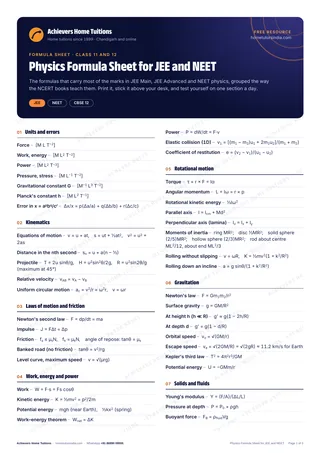 PDFFormula sheet · 3 pages, 169 KBPhysics Formula Sheet for JEE and NEETEvery formula from mechanics to modern physics, ready to print.
 PDFFormula sheet · 2 pages, 145 KBJEE Maths Formula SheetAlgebra, trigonometry, coordinate geometry, calculus, vectors and probability.
 PDFRevision notes · 2 pages, 137 KBNEET Biology High-Yield NotesThe NCERT facts NEET asks most: cell biology, genetics, physiology, ecology.