Revision notesClass 11 and 12
NEET Biology High-Yield Notes
NEET biology rewards exact NCERT facts. These notes collect the numbers, names and ratios that turn up again and again, chapter by chapter, so you can revise the whole syllabus in an evening.
 Open the PDF
01The cell
- Cell theory Schleiden and Schwann; Virchow added that new cells come from existing cells (omnis cellula e cellula)
- Ribosomes prokaryotes 70S (50S + 30S); eukaryotes 80S (60S + 40S)
- Semi-autonomous organelles mitochondria and chloroplasts have their own circular DNA and 70S ribosomes
- Membrane model fluid mosaic model, Singer and Nicolson (1972)
- Centrioles and cilia centriole 9 + 0 triplets; cilia and flagella 9 + 2 axoneme
- Lysosomes hydrolytic enzymes, active at acidic pH
02Cell cycle and division
- Interphase G1, S (DNA replicates), G2
- Mitosis metaphase is the best stage to study chromosome morphology
- Prophase I of meiosis synapsis in zygotene; crossing over in pachytene; chiasmata seen in diplotene; terminalisation in diakinesis
- Meiosis I reductional division; meiosis II is equational
03Molecular biology
- DNA structure Watson and Crick (1953); B-DNA has about 10 bp per turn and a pitch of 3.4 nm
- Base pairing A = T (2 hydrogen bonds); G ≡ C (3 hydrogen bonds); Chargaff's rule A + G = T + C
- Replication semi-conservative (Meselson and Stahl, using 15N); Okazaki fragments form on the lagging strand
- Genetic code triplet, degenerate, nearly universal; start codon AUG; stop codons UAA, UAG, UGA
- Lac operon Jacob and Monod; lactose (allolactose) is the inducer
- Human genome (NCERT figures) 3164.7 million bp; about 30,000 genes; under 2 per cent codes for proteins
04Genetics
- Mendelian ratios monohybrid F2 3:1 (genotype 1:2:1); dihybrid 9:3:3:1; test cross 1:1
- Incomplete dominance snapdragon flower colour, F2 1:2:1
- Co-dominance ABO blood groups (IA, IB, i)
- Sex determination humans XX–XY; grasshopper XX–XO; birds ZW female, ZZ male
- X-linked recessive haemophilia, colour blindness
- Sickle-cell anaemia glutamic acid replaced by valine at position 6 of β-globin
- Chromosomal disorders Down syndrome trisomy 21; Klinefelter 47,XXY; Turner 45,X0
05Human physiology
- Muscle contraction sliding filament theory; Ca2+ binds troponin, exposing actin's binding sites to myosin heads; ATP powers the cross-bridges
- Nerve impulse the Na+/K+ pump moves 3 Na+ out for every 2 K+ in; chemical synapses pass the signal with neurotransmitters such as acetylcholine
- Breathing tidal volume about 500 mL; vital capacity = IRV + TV + ERV
- Gas transport O2 about 97% as oxyhaemoglobin; CO2 about 70% as bicarbonate, 20–25% as carbaminohaemoglobin, 7% dissolved
- Heart SA node is the pacemaker (70–75 beats/min); cardiac output ≈ 70 mL × 72 ≈ 5 L/min; normal BP 120/80 mm Hg
- ECG P wave atrial depolarisation; QRS ventricular depolarisation; T wave ventricular repolarisation
- Kidney GFR about 125 mL/min (180 L/day); PCT reabsorbs 70–80% of water and electrolytes; ADH acts on DCT and collecting duct
- Hormones insulin (β cells) lowers blood glucose, glucagon (α cells) raises it; ADH and oxytocin are made in the hypothalamus and released by the posterior pituitary
06Plant physiology
- Photosystems PS I reaction centre P700; PS II P680; water splits at PS II
- C3 and C4 Calvin cycle's first stable product is 3-PGA; Hatch–Slack (C4) first product is OAA, with Kranz anatomy (maize, sugarcane)
- RuBisCO the most abundant enzyme on Earth; its oxygenase activity causes photorespiration in C3 plants
- Respiration glycolysis gives a net 2 ATP; Krebs cycle in the matrix; ETS on the inner membrane; NCERT net gain 38 ATP per glucose
- Respiratory quotient carbohydrates 1; fats about 0.7; proteins about 0.9
- Plant hormones auxin (apical dominance, rooting); gibberellins (bolting, malting); cytokinins (cell division, delay ageing); ethylene (ripening); ABA (stress, stomatal closure, dormancy)
07Reproduction
- Flowering plants double fertilisation, syngamy plus triple fusion (triploid endosperm)
- Menstrual cycle about 28 days; ovulation about day 14 after the LH surge; corpus luteum secretes progesterone
- Testes Sertoli cells nourish developing sperm; Leydig cells secrete testosterone
- Pregnancy implantation at the blastocyst stage; hCG maintains the corpus luteum
08Ecology
- Energy flow Lindeman's 10 per cent law; the pyramid of energy is always upright
- Inverted pyramids biomass in the sea; numbers in a single tree
- Species–area relationship log S = log C + Z log A, Z usually 0.1 to 0.2
- Biodiversity 34 hotspots worldwide; India has the Western Ghats–Sri Lanka, Indo-Burma and Himalaya
- Rivet popper hypothesis Paul Ehrlich
- Causes of loss (the Evil Quartet) habitat loss and fragmentation, over-exploitation, alien species invasions, co-extinctions
- Conservation in situ (biosphere reserves, national parks, sanctuaries, sacred groves); ex situ (zoos, botanical gardens, seed banks, cryopreservation)
09Biotechnology and health
- Restriction enzyme EcoRI cuts at GAATTC
- PCR denaturation, annealing, extension with Taq polymerase (Thermus aquaticus)
- Vector pBR322 ori, ampicillin and tetracycline resistance genes
- Bt crops cry genes from Bacillus thuringiensis; cryIAc and cryIIAb for cotton, cryIAb for corn
- RNA interference protects tobacco from the nematode Meloidogyne incognita
- Firsts gene therapy for ADA deficiency (1990); Rosie, the transgenic cow whose milk carried human α-lactalbumin (1997)
- Diseases malaria, Plasmodium via female Anopheles; typhoid, Salmonella typhi (Widal test); dengue and chikungunya via Aedes; filariasis, Wuchereria via Culex
- AIDS caused by HIV, a retrovirus that destroys helper T cells; ELISA detects infection
How to use these notes
- Read the matching NCERT paragraph after each section: NEET often lifts the exact sentence.
- Make your own list of examples (organisms, diseases, hormones); they are easy marks.
- Revise diagrams with labels: they carry both one-mark and assertion–reason questions.
Free PDF
Keep a copy.
The PDF prints cleanly on A4, 2 pages, 137 KB, with our WhatsApp number on every page.
Achievers Home Tuitions · since 1999
Want a Biology tutor for NEET?
One-to-one tutors at your home in Chandigarh, Mohali and Panchkula, or live online wherever you are. Our office confirms the tutor and the fee before the first class.
More free resources.
 PDFFormula sheet · 2 pages, 129 KBCBSE Class 12 Maths Formula SheetInverse trig, matrices, calculus, vectors, 3D lines, LPP and probability.
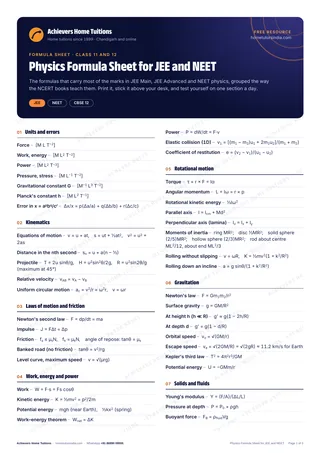 PDFFormula sheet · 3 pages, 169 KBPhysics Formula Sheet for JEE and NEETEvery formula from mechanics to modern physics, ready to print.
 PDFRevision notes · 2 pages, 150 KBChemistry Quick Revision for JEE and NEETPhysical chemistry formulas, periodic trends, bonding, named reactions and tests.