Practice testClasses 6 to 8
Maths Olympiad Practice Test for Classes 6 to 8
Twenty-five questions in the four sections of the SOF IMO paper, at Class 6 to 8 level: logical reasoning, mathematical reasoning, everyday mathematics and the achievers section, with an explanation for every answer.
 Open the PDF
25 questions, 33 marks. Pick an answer for each question, then press Check my answers: your score and an explanation for every question appear at once. Nothing you choose leaves this page.
01Before you start
- Time 30 minutes, with a clock in view
- Marks 1 mark for each question in Sections 1 to 3 and 3 marks in the Achievers section: 33 marks in all
- Wrong answers no marks are taken off, so answer every question
- The real paper the SOF IMO for Classes 5 to 12 has 50 questions for 60 marks in 60 minutes
02Logical reasoning1 mark each
1Find the next number: 2, 6, 12, 20, 30, ___
2Find the odd one out.
3In a code, MATH is written as NBUI. How is SCORE written?
4Pointing to a man, Anu says, 'He is the son of my grandfather's only son.' How is the man related to Anu?
5What is the angle between the hands of a clock at 3:30?
61 January of a non-leap year is a Monday. What day is 1 February?
03Mathematical reasoning1 mark each
7What is the HCF of 84 and 126?
8(−3) × (−4) − (−5) = ___
9If 3x − 7 = 2x + 5, then x = ___
1025 × 23 ÷ 26 = ___
11The angles of a triangle are in the ratio 2 : 3 : 4. What is the largest angle?
12√1764 = ___
13Which is the smallest?
14How many diagonals does a hexagon have?
04Everyday mathematics1 mark each
15A shirt marked ₹800 is sold at 15% off. What is the selling price?
16A car travels 180 km in 3 hours. At the same speed, how far does it go in 5 hours?
17What is the simple interest on ₹5,000 at 8% a year for 3 years?
18The average of five numbers is 24. When one number is removed, the average of the other four is 22. Which number was removed?
19One pipe fills a tank in 6 hours and another in 3 hours. How long do they take together?
20A recipe uses flour and sugar in the ratio 5 : 2. How much sugar goes with 750 g of flour?
21A cube has 4 cm edges. What is its total surface area?
05Achievers section3 marks each
22What is the remainder when 210 is divided by 7?
23How many whole numbers from 1 to 100 are divisible by 3 or by 5?
24The digits of a two-digit number add up to 9. Reversing the digits gives a number 27 more. What is the number?
25A square and an equilateral triangle have the same perimeter. Each side of the triangle is 12 cm. What is the area of the square?
Show the answer key
Answers and explanations
- 1BThe gaps are 4, 6, 8, 10, so the next gap is 12: 30 + 12 = 42. (Each term is n × (n + 1).)
- 2C121 = 112, 169 = 132 and 196 = 142, but 210 is not a perfect square.
- 3BEach letter moves one step forward: S → T, C → D, O → P, R → S, E → F.
- 4DHer grandfather's only son is her father, and her father's son is her brother.
- 5AThe minute hand is at 180°. The hour hand is halfway between 3 and 4, at 105°. 180° − 105° = 75°.
- 6CJanuary has 31 days, which is 4 weeks and 3 days, so 1 February is 3 days on from Monday: Thursday.
- 7D84 = 22 × 3 × 7 and 126 = 2 × 32 × 7, so the HCF is 2 × 3 × 7 = 42.
- 8A(−3) × (−4) = 12, and 12 − (−5) = 12 + 5 = 17.
- 9CTake 2x from both sides: x − 7 = 5, so x = 12.
- 10BAdd and subtract the powers: 5 + 3 − 6 = 2, and 22 = 4.
- 11D2 + 3 + 4 = 9 parts make 180°, so one part is 20° and the largest angle is 4 × 20° = 80°.
- 12B402 = 1600 and 422 = 1764.
- 13AAs decimals: 2/5 = 0.40, 3/7 ≈ 0.43, 4/9 ≈ 0.44 and 5/11 ≈ 0.45.
- 14CA polygon with n sides has n(n − 3)/2 diagonals: 6 × 3 ÷ 2 = 9.
- 15D15% of 800 is 120, and 800 − 120 = 680.
- 16ASpeed = 180 ÷ 3 = 60 km an hour, so in 5 hours it goes 300 km.
- 17C5,000 × 8 × 3 ÷ 100 = 1,200. (₹6,200 is the total amount, not the interest.)
- 18BThe five add up to 5 × 24 = 120 and the four to 4 × 22 = 88, so the removed number is 120 − 88 = 32.
- 19DIn one hour they fill 1/6 + 1/3 = 1/2 of the tank, so together they take 2 hours.
- 20COne part is 750 ÷ 5 = 150 g, so 2 parts of sugar are 300 g.
- 21A6 faces, each 4 × 4 = 16 square cm: 6 × 16 = 96. (64 is the volume in cubic cm.)
- 22C210 = 1024 = 7 × 146 + 2. (Or: 23 = 8 leaves 1, so 29 leaves 1 and 210 leaves 2.)
- 23B33 multiples of 3, plus 20 multiples of 5, minus the 6 multiples of 15 counted twice: 33 + 20 − 6 = 47.
- 24DReversing adds 9 × (difference of the digits), so the digits differ by 3 and add up to 9: 3 and 6, giving 36. Check: 63 − 36 = 27.
- 25AThe perimeter is 3 × 12 = 36 cm, so the square's side is 9 cm and its area 81 square cm.
How to use this test
- Time yourself: 30 minutes for this test is the pace of the real paper.
- In the achievers section, write down what you know before you calculate.
- Keep a notebook of every question you got wrong, with the right method.
Free PDF
Keep a copy.
The PDF prints cleanly on A4, 3 pages, 204 KB, with our WhatsApp number on every page.
Achievers Home Tuitions · since 1999
Want a Maths Olympiad tutor?
One-to-one tutors at your home in Chandigarh, Mohali and Panchkula, or live online wherever you are. Our office confirms the tutor and the fee before the first class.
More free resources.
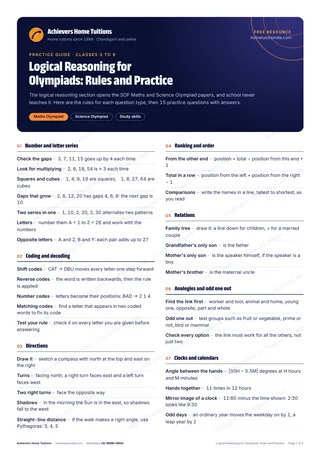 PDFPractice guide · 3 pages, 183 KBLogical Reasoning for Olympiads: Rules and PracticeSeries, codes, directions, ranking, relations, clocks and figure counting, with 15 practice questions.
 PDFFormula sheet · 3 pages, 163 KBIOQM and RMO Toolkit: Theorems, Formulas and PracticeThe theorems IOQM and RMO lean on, the paper pattern, and 10 practice problems with answers.
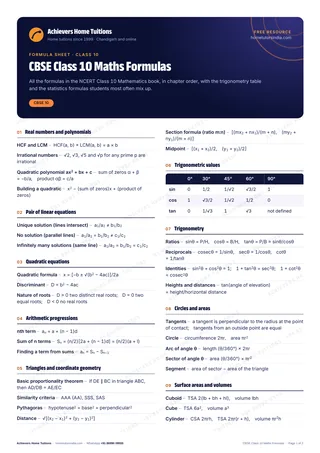 PDFFormula sheet · 2 pages, 133 KBCBSE Class 10 Maths FormulasEvery formula in the NCERT Class 10 book, chapter by chapter, with the trig table.