Formula sheetYears 10 and 11
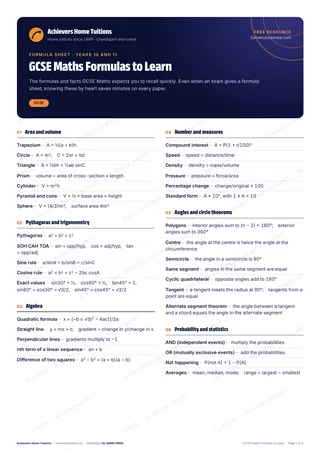
GCSE Maths Formulas to Learn
The formulas and facts GCSE Maths expects you to recall quickly. Even when an exam gives a formula sheet, knowing these by heart saves minutes on every paper.
 Open the PDF
01Area and volume
- Trapezium A = ½(a + b)h
- Circle A = πr2, C = 2πr = πd
- Triangle A = ½bh = ½ab sinC
- Prism volume = area of cross-section × length
- Cylinder V = πr2h
- Pyramid and cone V = ⅓ × base area × height
- Sphere V = (4/3)πr3, surface area 4πr2
02Pythagoras and trigonometry
- Pythagoras a2 + b2 = c2
- SOH CAH TOA sin = opp/hyp, cos = adj/hyp, tan = opp/adj
- Sine rule a/sinA = b/sinB = c/sinC
- Cosine rule a2 = b2 + c2 − 2bc cosA
- Exact values sin30° = ½, cos60° = ½, tan45° = 1, sin60° = cos30° = √3/2, sin45° = cos45° = √2/2
03Algebra
- Quadratic formula x = [−b ± √(b2 − 4ac)]/2a
- Straight line y = mx + c; gradient = change in y/change in x
- Perpendicular lines gradients multiply to −1
- nth term of a linear sequence an + b
- Difference of two squares a2 − b2 = (a + b)(a − b)
04Number and measures
- Compound interest A = P(1 + r/100)n
- Speed speed = distance/time
- Density density = mass/volume
- Pressure pressure = force/area
- Percentage change change/original × 100
- Standard form A × 10n, with 1 ≤ A < 10
05Angles and circle theorems
- Polygons interior angles sum to (n − 2) × 180°; exterior angles sum to 360°
- Centre the angle at the centre is twice the angle at the circumference
- Semicircle the angle in a semicircle is 90°
- Same segment angles in the same segment are equal
- Cyclic quadrilateral opposite angles add to 180°
- Tangent a tangent meets the radius at 90°; tangents from a point are equal
- Alternate segment theorem the angle between a tangent and a chord equals the angle in the alternate segment
06Probability and statistics
- AND (independent events) multiply the probabilities
- OR (mutually exclusive events) add the probabilities
- Not happening P(not A) = 1 − P(A)
- Averages mean, median, mode; range = largest − smallest
How to use this sheet
- Write the formula before substituting in every answer; method marks reward it.
- Learn circle theorems with a sketch each: you must quote the reason in words.
- Always check whether your calculator is in degrees.
Free PDF
Keep a copy.
The PDF prints cleanly on A4, 2 pages, 117 KB, with our WhatsApp number on every page.
Achievers Home Tuitions · since 1999
Want a GCSE Maths tutor?
One-to-one tutors at your home in Chandigarh, Mohali and Panchkula, or live online wherever you are. Our office confirms the tutor and the fee before the first class.
More free resources.
 PDFFormula sheet · 2 pages, 145 KBJEE Maths Formula SheetAlgebra, trigonometry, coordinate geometry, calculus, vectors and probability.
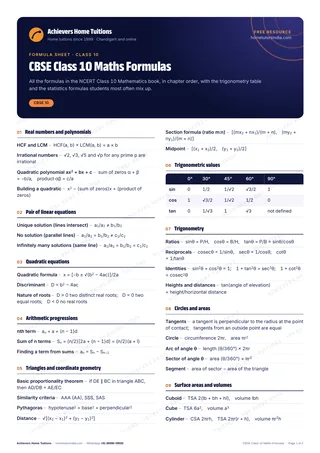 PDFFormula sheet · 2 pages, 133 KBCBSE Class 10 Maths FormulasEvery formula in the NCERT Class 10 book, chapter by chapter, with the trig table.
 PDFFormula sheet · 2 pages, 129 KBCBSE Class 12 Maths Formula SheetInverse trig, matrices, calculus, vectors, 3D lines, LPP and probability.